

Installing rooftop solar is the first step toward decarbonization. But for a factory aiming to run on 100% renewable electricity, solar alone is rarely enough once roof space and night-time consumption are taken into account. Companies working toward carbon neutrality can take steps such as:
- Improving energy efficiency and switching to high-efficiency equipment
- Using renewable energy certificates (I-RECs)
- Introducing EVs and electrified equipment
This article looks at one of these, the I-REC: how it works, its advantages and drawbacks, how companies use it, and how the market is developing in Indonesia.
What is an I-REC?
An I-REC (International Renewable Energy Certificate) is an internationally recognized certificate issued for every 1MWh of electricity generated from renewable sources such as solar, wind and hydropower. By using the certificate to declare that their electricity comes from renewable sources, companies can report reductions in their Scope 2 greenhouse gas emissions.
I-RECs are gaining attention as an objective way for companies to show their environmental contribution. In Japan, for example, the non-profit Local Good Creation Support Organization began a pilot as an issuer in July 2021 and widened the scope of issuance in January 2023 [1].
Advantages of I-RECs
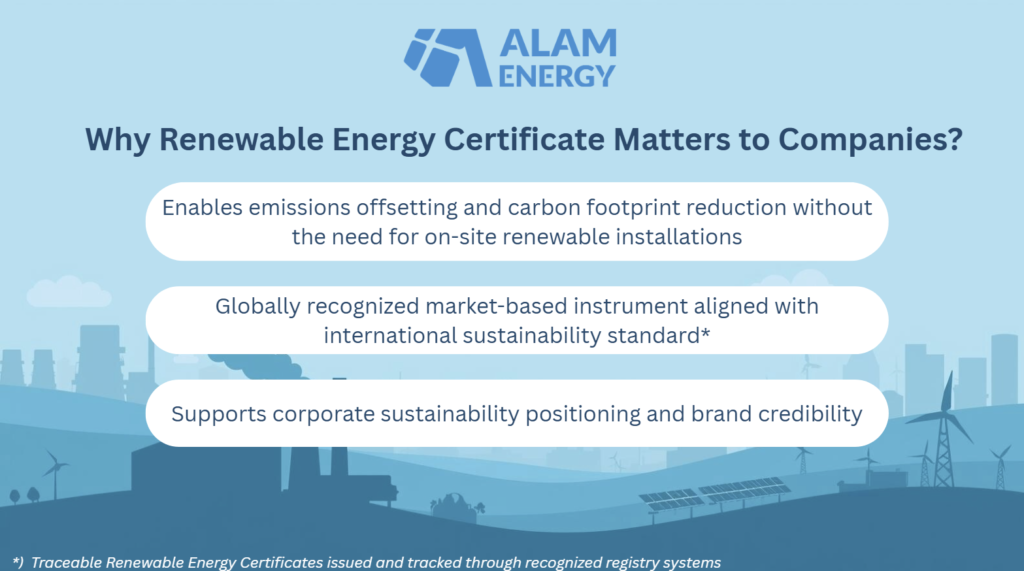
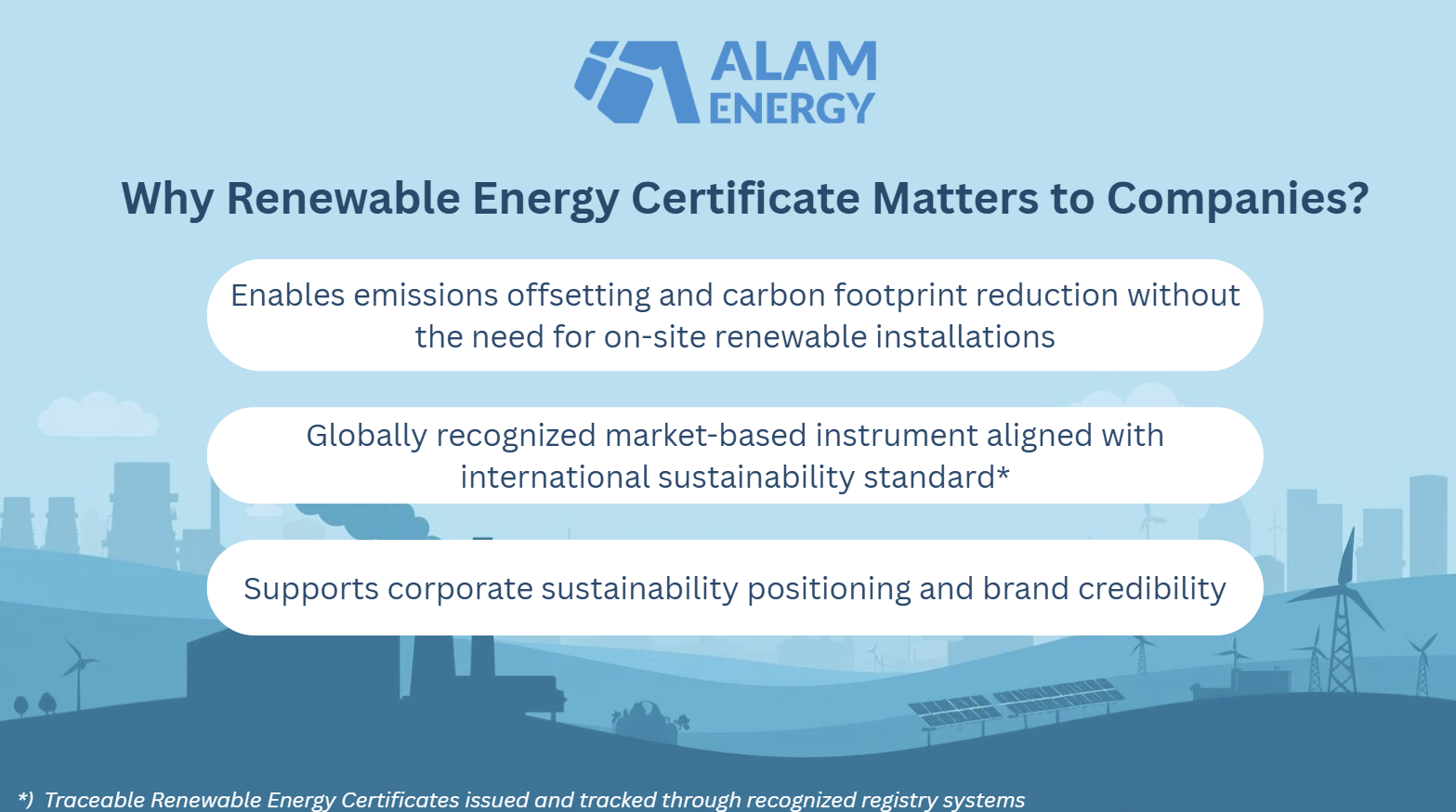
They reduce Scope 2 emissions
Purchasing I-RECs allows the electricity you consume to be counted as renewable. They can also be used for CDP (Carbon Disclosure Project) reporting and RE100 commitments.
No renewable assets of your own are needed
Factories and warehouses where roof area or structural limits make solar difficult can still acquire the environmental value of renewable electricity, separately from their power supply contract.
They follow international standards
I-RECs are aligned with major international frameworks including the GHG Protocol, CDP and RE100, so they fit into a global ESG strategy.
They support external communication
Your use of I-RECs can be included in CSR and sustainability reports and used to explain your efforts to customers and business partners.
Drawbacks of I-RECs
They must be purchased on an ongoing basis
If a company relies only on I-RECs to meet its targets, it usually needs to buy certificates equal to a full year of electricity use every year, which is a recurring cost.
Issuers and supply are limited in Indonesia
In Indonesia the number of issuers (mainly PLN and renewable energy producers) is still limited, and the timing and volume of issuance can be constrained.
Redemption has to be managed
An I-REC only counts as environmental value once it has been redeemed. Registration and redemption therefore have to be managed through an exchange or a third-party platform.
How companies use I-RECs
There are two ways to use I-RECs: issue them yourself, or buy them from others.
Issuing your own I-RECs
A company can issue I-RECs based on the output of renewable generation assets it owns, such as on-site solar. Registration under the I-REC Standard and a third-party audit are required, but the issued certificates can be used in-house or sold to other companies.
Buying I-RECs
For companies that find it difficult to install their own renewable assets, buying I-RECs issued by others is a practical option. Because the barrier to entry is relatively low, the use of renewable electricity through I-REC purchases is spreading quickly, led by global companies.
The situation in Indonesia
I-REC use has grown rapidly in Indonesia over the past few years, as foreign-owned companies and export-oriented manufacturers adopt them to meet CDP and RE100 requirements. The REC scheme began in 2020, and by the end of 2023 more than 5TWh had been supplied to around 296 companies through PLN. In July 2025 a REC exchange was formally launched on the Indonesia Commodity and Derivatives Exchange (ICDX), which is expected to strengthen the system and expand the market [2].
Domestically, the state utility PLN and its subsidiaries (such as PLN Nusantara Power) are certified as I-REC issuers and issue certificates mainly from large hydropower plants. As private investment in renewables grows, the number of issuers outside PLN is also increasing, and the market is expected to diversify further.
At the same time, few renewable projects can issue certificates yet, so supply may tighten, leading to higher prices or limited availability. If you already know how many certificates you will need, we recommend planning your procurement early.
Combining solar with I-RECs
In addition to on-site solar, Alam Energy offers renewable energy certificates under the I-REC Standard as part of our decarbonization solutions. The certificates come from hydropower plants in Sumatra and other regions owned by companies in which our group has invested, so their generation source can be traced.
By combining solar with I-RECs, companies can:
- Cover the gap between on-site solar generation and total electricity consumption
- Make renewable energy claims for sites where solar cannot be installed, without additional assets
- Report in line with the GHG Protocol, CDP and RE100
- Back CSR reports and stakeholder disclosures with credible figures
On-site solar provides the foundation, and I-RECs cover the rest of the way to 100% renewable electricity. For a quotation or a proposal tailored to your sites, contact us at contact@alamenergy.co.id.